Ethereum Staking & Restaking

Ethereum Staking & Restaking: A Risk Framework for Institutional Allocators
Executive Summary
The emergence of restaking protocols has introduced incremental yield opportunities within Ethereum’s validator ecosystem while simultaneously creating novel risk vectors that warrant careful institutional due diligence. This note examines the structural differences between native staking and restaking, identifies key risk transmission mechanisms, and evaluates architectural approaches to risk containment.
Key Investment Considerations:
- Restaking compounds security assumptions by layering multiple protocol exposures onto identical collateral
- Slashing risk under restaking regimes is non-isolated; fault propagation across Actively Validated Services (AVSs) represents systemic rather than idiosyncratic risk
- Delegation structures introduce principal-agent dynamics that may obscure underlying risk exposures
- Temporal gaps between AVS-level fault detection and Ethereum-layer enforcement create windows of unpriced risk
- Infrastructure architecture and loss absorption mechanisms should be weighted equally alongside yield considerations in allocation decisions
Structural Overview: Staking vs. Restaking
Native Staking
Under Ethereum’s Proof of Stake consensus mechanism, validators commit 32 ETH as collateral to participate in block proposal and attestation. This capital provides cryptoeconomic security to the base layer, with validators earning yield through protocol rewards. The penalty structure, which includes slashing for provable misbehavior and inactivity leakage for offline validators, creates incentive alignment with network integrity.
Restaking Architecture
Restaking, formalized through the EigenLayer protocol (whitepaper: Q1 2023), enables validators and liquid staking token holders to extend their staked ETH as collateral securing additional middleware protocols. Actively Validated Services (AVSs) can inherit Ethereum’s economic security without establishing independent validator sets. This includes data availability layers, cross-chain bridges, and oracle networks.
The economic rationale is straightforward: AVSs compensate validators for shared security guarantees, generating supplemental yield. The architecture separates stakers, operators, and AVSs by design, with opt-in risk selection and programmable slashing conditions.
Risk Transmission Mechanisms
1. Compounding Slashing Exposure
In native staking environments, slashing events typically remain isolated to individual validators. Experienced operators maintain sufficient operational discipline to avoid correlation penalties that would amplify losses.
Restaking fundamentally alters this risk profile. Each incremental AVS introduces distinct slashing conditions, and there is no inherent coordination mechanism ensuring these conditions remain non-conflicting. Operational errors that would have remained contained under native staking can propagate across multiple protocol layers.
2. Correlated Risk Across AVS Exposure
When identical collateral secures multiple AVSs, the portfolio exhibits concentrated rather than diversified risk characteristics. A single implementation vulnerability or exploit vector can trigger simultaneous slashing across all exposed protocols. This represents systemic contagion risk at the protocol layer, distinct from but analogous to cross-validator correlation penalties at the network layer.
3. Principal-Agent Dynamics in Delegation
The majority of restaking capital flows through delegation to specialized operators, a rational response to operational complexity. However, delegation introduces meaningful distance between capital providers and critical decision vectors: AVS selection, upgrade timing, and risk tolerance calibration.
AVS infrastructure remains nascent, and behavioral characteristics under stress conditions are largely untested. Importantly, the current market structure concentrates downside exposure among delegators rather than operators, a misalignment that sophisticated allocators should factor into counterparty assessments.
Architectural Approaches to Risk Containment
Given the structural risks outlined above, infrastructure selection criteria should emphasize containment mechanisms alongside yield optimization. Certain protocol architectures have been designed with explicit assumptions that operational failures will occur, engineering accordingly.
Modular Risk Isolation
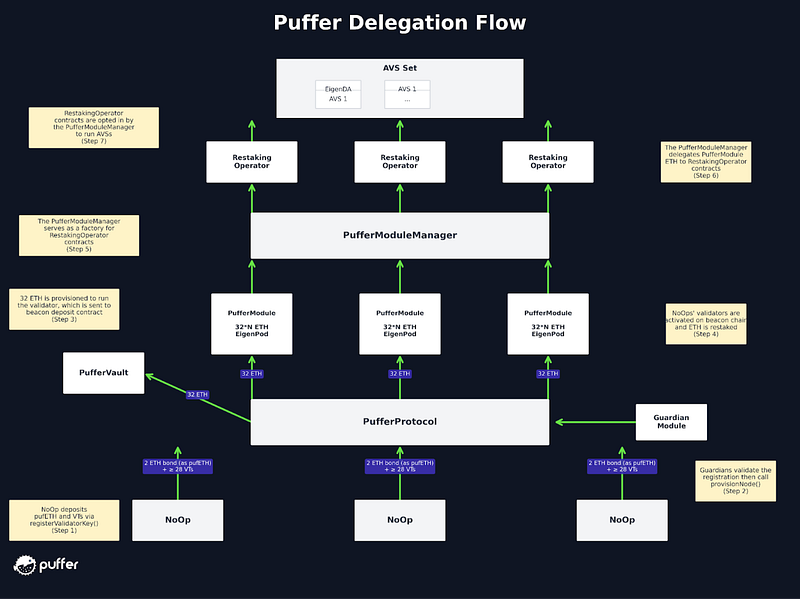
Leading infrastructure providers utilize compartmentalized contract architectures, such as discrete RestakingModule contracts controlling individual EigenPods backed by multiple node operators. This structure enables:
- Protocol-level determination of AVS allocation per module
- Distribution of restaked capital according to defined risk preferences
- Operator self-selection into modules aligned with their risk tolerance
First-Loss Capital Requirements
A critical differentiator in infrastructure evaluation is the loss absorption hierarchy. Architectures requiring meaningful operator bond capital (e.g., 2 ETH per operator) materially alter incentive structures versus fee-only models.
From a risk allocation perspective, this design ensures operator capital absorbs initial losses before delegated institutional capital is impaired. Quantitatively, Ethereum correlation penalties would need to reach extreme, network-level failure thresholds before such bonds are exhausted. That’s a tail risk scenario, not ordinary operational variance.
Conservative AVS Curation
Infrastructure providers maintaining discretionary AVS selection processes, limiting exposure to vetted protocols with established track records, reduce the attack surface for delegated capital. While permissionless systems offer long-term scalability benefits, risk transfer to end-users frequently precedes adequate tooling maturity. A staged approach, expanding AVS eligibility as the ecosystem develops appropriate risk infrastructure, represents prudent fiduciary positioning.
Due Diligence Framework for Institutional Allocators
Regardless of infrastructure selection, allocation decisions should address the following:
- Risk Allocation Structure: How is AVS exposure distributed across the capital stack?
- Loss Absorption Hierarchy:Who bears first-loss exposure, operators or delegators?
- Governance Mechanisms: What controls exist around AVS selection and operator eligibility?
- Incentive Alignment:Are operators compensated solely through fees, or do they maintain capital at risk?
Conclusion
Restaking represents a meaningful evolution in Ethereum’s economic security model, offering both enhanced yield opportunities and expanded risk complexity. Institutional allocators should approach this asset class with frameworks emphasizing infrastructure architecture and loss containment mechanisms alongside return optimization. The protocols demonstrating rigorous risk engineering today are likely to capture disproportionate institutional flows as this market matures.
This analysis is provided for informational purposes and does not constitute investment advice.