
How Puffer & Anchorage Bring Restaking to Institutions

Anchorage Digital recently announced a partnership with Puffer Finance to give institutional clients access to pufETH. That means regulated access to Ethereum staking and EigenCloud restaking yields.
This piece walks through the infrastructure that makes the setup possible, and where some of the design trade-offs quietly sit.
What is pufETH?
pufETH is Puffer’s liquid restaking token.
An institution deposits ETH into Puffer and receives pufETH in return. That ETH is then assigned to validators participating in Ethereum consensus. Through EigenCloud, those same validators can also secure additional protocols.
Unlike some alternative liquid restaking tokens, pufETH does not rebase. Yield accrues as the exchange rate between pufETH and ETH appreciates, so over time, each pufETH represents more underlying ETH. There are no claim steps or manual restaking flows; rewards are reflected directly in the token’s redemption value.
For firms transiting through Anchorage, this structure likely reduces operational friction. There is one asset to custody and account for, but it reflects two separate sources of yield. No validator fleet to run. No restaking contracts to integrate directly.
It is simple at the surface, though the system underneath is anything but.
Decentralised operator architecture and slashing protection
This is where Puffer’s design starts to look meaningfully different from most liquid staking setups.
The standard industry pattern is to concentrate validation with a small group of professional operators. Efficient and easier to manage, but there is an obvious clustering risk. When one large operator suffers an outage or gets slashed, a material portion of the stake can be affected all at once.
Puffer takes a different path. It is the first permissionless native restaking protocol on EigenCloud, which means anyone with 2 ETH can run a validator. No gatekeeping, no application process. Anyone with 2 ETH can spin up a validator. Which means institutions end up with validation spread across many independent operators running different infrastructure and operational stacks.
This isn’t just about philosophy, as risk engineering is equally important. When operators are genuinely diverse, failures tend to be independent rather than correlated. One exploit or mistake is less likely to cascade across the validator set. For institutional risk teams, this structure probably feels closer to diversified counterparty exposure than trusting a handful of critical service providers.
Of course, permissionless participation raises an obvious question: what happens when something goes wrong? Every Node Operator posts a 2 ETH bond as collateral. This is not a fee. It is skin in the game. If that operator’s validator gets slashed, the bond absorbs the damage before any loss reaches pufETH holders. Think of it as active insurance funded by the operators actually taking on risk. At the aggregate level, this adds up to roughly five billion dollars of economic protection at current ETH prices. Instead of accepting “slashing is rare” as an article of faith, there is a quantifiable buffer you can model. The bond structure also aligns incentives: operators have their own capital exposed, so poor performance costs them directly.
Validator Tickets and protocol safeguards
In most liquid staking protocols, stakers earn rewards based on how well validators actually perform. If an operator underperforms or goes offline frequently, rewards suffer. Stakers absorb that risk whether they signed up for it or not.
Puffer flips this with Validator Tickets (VTs).
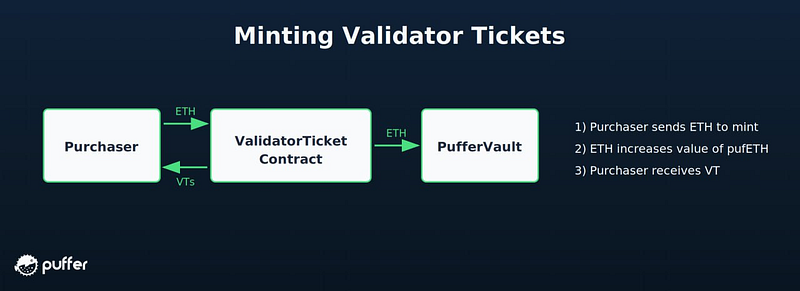
To run a validator, an operator purchases VTs upfront. Each ticket represents one validator-day of expected PoS rewards, and that payment flows directly to pufETH holders immediately. Staker rewards get decoupled from operator performance. If an operator later underperforms, they cannot claw back the cost of tickets already purchased. The economics punish laziness directly. For operators who perform well, they keep 100% of the PoS and MEV rewards their validator generates. Outperform the expected average, and you profit. Underperform, and you lose. But economic incentives alone do not make a permissionless protocol safe. That is where Puffer’s Guardians come in. Guardians are trusted community members who handle three responsibilities: ejecting validators whose balance drops too low, vetting new registrations before provisioning 32 ETH, and returning bonds when validators exit cleanly. If a registration is invalid, Guardians skip it and the operator forfeits a portion of their VTs to prevent griefing. This is not permanent infrastructure. The guardian role is designed to phase out once EIP-7002 gets adopted and trustless validator ejection becomes possible.
How the Anchorage Digital integration works
Through the partnership, Anchorage Digital clients can mint or acquire pufETH directly within the Anchorage platform.
From a technical perspective, institutions do not need to connect to external decentralised applications or sign opaque transaction payloads. Custody, compliance workflows and internal controls remain within Anchorage Digital’s platform. Yield generation is handled by the Puffer protocol underneath.
This setup addresses a long-standing friction point. Many institutions have avoided staking because participation usually meant either giving up custody or building complex integrations with multiple external providers.
The combined architecture appears to close that gap. Whether it holds up operationally at scale is something only time will reveal.
Why this matters
Staking, and increasingly restaking, are becoming part of Ethereum’s base economic layer. For institutions holding large ETH balances, ignoring those systems may no longer be a realistic long-term position.
Participation, however, has to happen on institutional terms. That usually means qualified custody, clearly defined risk boundaries, and infrastructure that assumes things will fail occasionally rather than pretending they will not.
This partnership brings those components together. Anchorage Digital supplies the custody and regulatory framework. Puffer supplies staking and restaking infrastructure that is built around operator dispersion, bonded slashing protection and operational isolation.
For institutions evaluating how to access staking and restaking in practice, this appears to be one of the more carefully engineered options available today.
Puffer is a leading innovator in Ethereum infrastructure, focusing on next-generation rollups supported by liquid restaking (LRT) and preconfirmation as an AVS. With products like Puffer UniFi and Puffer UniFi AVS on EigenLayer, we are dedicated to enhancing Ethereum’s decentralization. Visitpuffer.fifor more information.