Introducing PufferDAO A Community-Driven Decision-Making Framework

Introducing PufferDAO A Community-Driven Decision-Making Framework
TL;DR
- PufferDAO Overview: PufferDAO empowers the community to shape Puffer’s future, aligning with Ethereum’s ethos of decentralization.
- $PUFFER and vePUFFER: Stake $PUFFER to mint vePUFFER NFTs, gain voting power that grows linearly up to 2x over time, and drive key decisions for Puffer’s ecosystem, including Puffer LRT, UniFi Based Rollup and UniFi AVS.
- Governance Workflow: Proposals move through creation, discussion, review, and voting, ensuring transparency and community involvement in decision-making.
- Roadmap to Decentralization:Gradual governance phases, from initial off-chain voting to fully autonomous on-chain governance, foster scalability and innovation.
Across the Web3 landscape, the prevalence of centralization has given rise to systemic inefficiencies by concentrating power and creating an environment at risk of misaligned interests. In contrast, decentralized governance offers a powerful alternative by distributing decision-making to a broader community, and in turn, strengthens overall transparency and accountability. These principles are fundamentally important to us and are key to shaping Puffer’s future.
In addition to providing a democratic structure that aligns Puffer’s evolution with the interests of our community, decentralized governance supports our vision to uphold Ethereum’s core ethos of decentralization. By empowering stakeholders to help steer the direction of upgrades and policies, decentralized governance preserves Ethereum’s vision of equitable, permissionless systems.
With this in mind, the introduction of Puffer Governance signals our commitment to decentralized protocol management, and in this article, we’ll outline the framework that drives our Governance including the PUFFER token, the staking mechanism that enables our voting, and a governance workflow overview. Let’s dive in.
A New Standard for Decentralization
Transitioning to a Decentralized Autonomous Organization (DAO) is a fundamental step in our mission to create a decentralized financial ecosystem that empowers users, fosters innovation at the grassroots level, and upholds Ethereum’s core principles. This move ensures that the future Puffer landscape is configured by our rapidly expanding community of token holders and ecosystem participants. Through the DAO, we’re not just advocating for decentralization — we’re embodying it, allowing our governance to reflect the very values we seek to promote in the broader Ethereum ecosystem.
The Role of the PUFFER Token
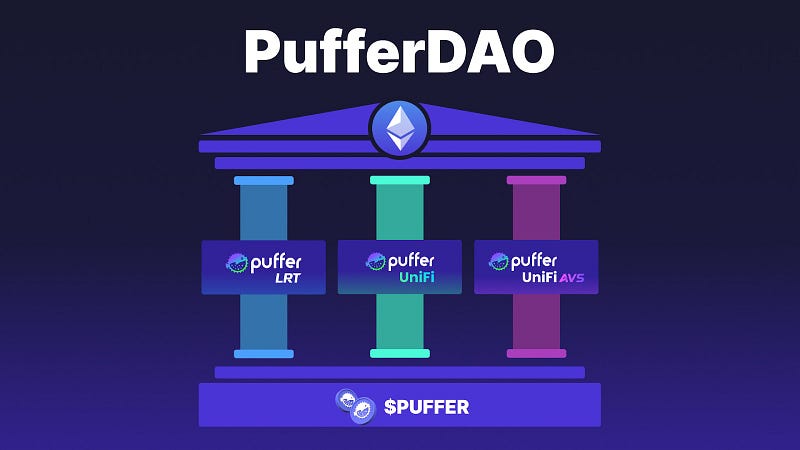
As our Governance token, PUFFER will play a key role across our suite of solutions. PUFFER token holders will be able to vote on key decisions that shape the future of the ecosystem, such as protocol upgrades, fee adjustments, and new feature proposals for UniFi AVS, UniFi Rollup, and Puffer Liquid Restaking Token (LRT). All three products will generate treasury rewards, of which future PUFFER holders will be responsible for managing and driving long-term sustainability. Here is a breakdown of the specific use cases for PUFFER, regarding LRT, UniFi AVS, and UniFi Rollup:
Puffer LRT
- Govern key protocol parameters (fees, limits, bond requirements)
- Select guardians and restaking operators
- Curate supported AVSs
- Future feature: Help allocate ETH to different operators and AVSs (more details coming soon)
UniFi AVS
- Manage fee structures
- Whitelist new rollups for AVS support
- Oversee AVS security parameters
- Guide the integration of new preconfirmation and proposer commitment services
UniFi Rollup
- Set fee parameters for rollup transactions
- Direct ecosystem rewards to promote adoption
- Manage treasury funds for long-term sustainability
- Steer rollup upgrade decisions and feature prioritization
The veToken Approach
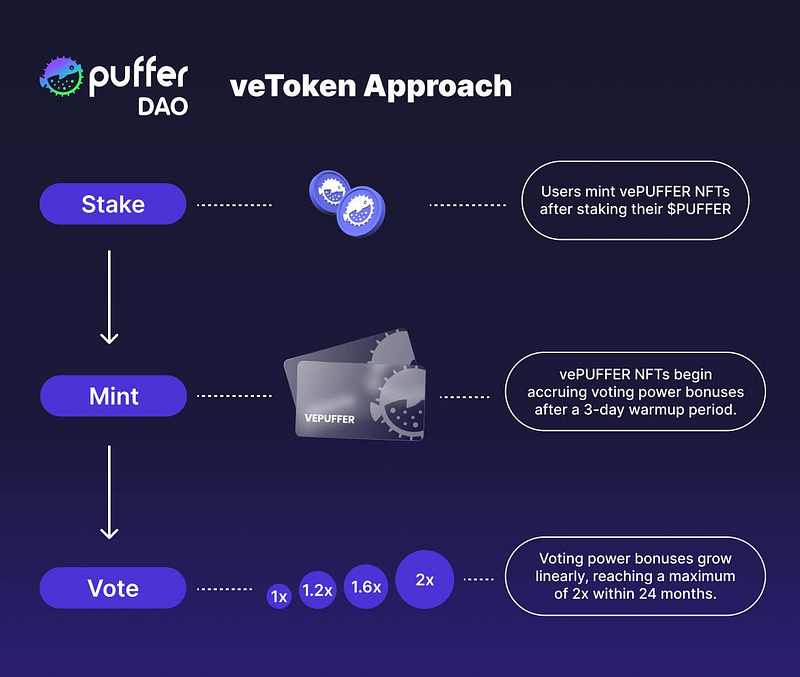
For Puffer’s governance, we’re building upon the veToken standard and innovating with our vePUFFER NFTs, which are minted after a user stakes their PUFFER. The vePUFFER NFT will begin accruing a voting power bonus after a minimum warmup period of 3 days, this bonus accumulates linearly until it reaches 2x (which takes 24 months).
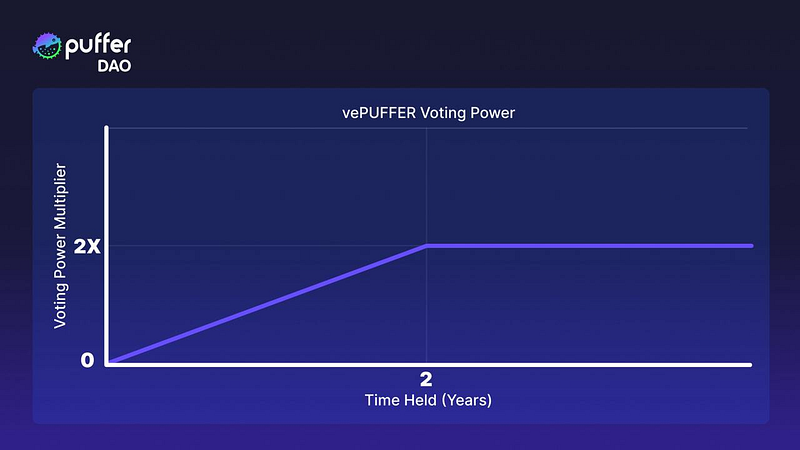
This voting power bonus incentivizes longer-term participation and provides an individual *or entity with a larger representation within the PufferDAO.
*It’s worth noting that if a user decides to unstake, they will lose their voting power multiplier.
The original veToken locking mechanism has been viewed as a positive tool to encourage long-term participation, however, internally we decided against lengthy 6–8 month locks. Instead, we’ve designed a nuanced approach that balances protocol stability with individual user needs, incorporating a minimum lock period of 30 days — which begins once a user stakes their PUFFER tokens — and a 30-day exit queue.
Let’s take a look at how this works in practice:
- User A stakes and decides to exit two weeks later. In this instance, user A must satisfy the ‘Min Lock’ period (30 days), and then join the ‘Exit Queue’ (30 days). As user A has already been staked for two weeks, the ‘Min Lock’ period only requires another two weeks before it is satisfied. After this period, user A can join the ‘Exit Queue’ and will be able to withdraw after 30 days.
- User B has been staked for three months and decides they would like to exit. User B has already satisfied the ‘Min Lock’ period, and therefore can immediately join the ‘Exit Queue’ and will be able to withdraw after 30 days.
Governance Model
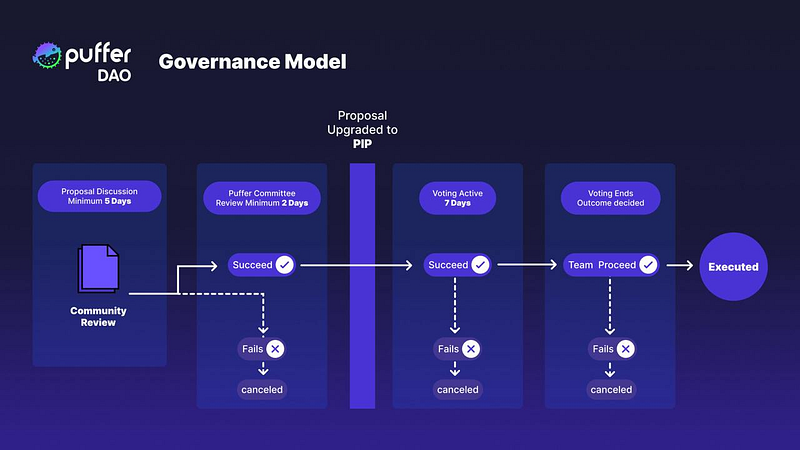
Our governance proposal model is structured around four key stages: Creation, Discussion, Review, and Voting. This systematic approach ensures comprehensive community involvement and a rigorous proposal evaluation.The Puffer Governance forum will be home to all governance-related discussions and is designed to facilitate healthy debate amongst current partners and any potential future partnership protocols.
Governance can get complicated quickly, especially as a protocol navigating multiple complex products, therefore we’ve selected key topics and siloed them in separate categories to help reduce cross-product confusion.
- Governance: Ecosystem-wide discussions
- AVS/Node Ops: Onboarding AVS and Node Operator strategies
- Proposal: Puffer Improvement Proposals (PIPs)
- Incentives: Season-specific discussions
- Resources: Supporting guides and materials
Governance Workflow
Proposal creation
We are building an ecosystem in which anyone can create a proposal, democratizing the governance process. Proposals should initially be posted in their respective category (as mentioned above)and will be updated to a PIP by the Governance Admin team. For a proposal to be successfully updated, you should use the designated Proposal Template and make sure to provide the following details:
- Comprehensive description
- Clear rationale
- Expected benefits
- Potential risks
Submitted proposals are posted on the Puffer Governance Forum for community review. We anticipate future improvements, such as a permissionless submission system with potential submission fees.
Proposal discussion
Theminimum five-days discussion period allows community members to:
- Provide feedback
- Debate proposal merits
- Suggest refinements
The Puffer Governance Forum is the primary platform for these discussions, ensuring a transparent and collaborative evaluation of all proposals.
Proposal review
The Puffer Governance Review Committee plays a critical role in assessing proposal readiness. The committee evaluates proposals based on several criteria, including, but not limited to:
- Community feedback
- Alignment with Puffer’s long-term goals
- Feasibility of implementation
The minimum two-day review process ensures only quality proposals advance to the voting stage. The committee will:
- Finalize and prepare Approved proposals for voting.
- Request additional refinement from Proposals authors, feedback included if required.
- Archive any rejected proposals with documented reasons for transparency.
To ensure timely inclusion in governance, approved proposals are queued for the next available Voting Epoch.
Proposal voting
The final stage of the governance process is voting, exclusive to vePUFFER holders and conducted through the Puffer Voting Platform. Key voting guidelines include:
- Seven-day voting epoch
- Occurs every other Thursday at 12am UTC
- Flexible quorum
- Simple majority determines proposal passage
Results are tallied after the voting period and shared through the Governance Forum and official communication channels.
Each Voting Epoch lasts for seven calendar days and it happens every other Thursday 12am UTC time.
Roadmap
Our transition to full community governance will take place at a gradual, methodical pace, with designated phases designed to ensure a smooth, secure, and effective implementation.
From Phase 0 to Phase 3, our roadmap has been meticulously engineered to enable broad community participation in key discussions and decision-making, as part of our commitment to maintain the highest standards of transparency across all governance processes, while balancing innovation with security and stability.
Phase 0: Initial Allocation and Off-Chain Voting
- Launch of the PUFFER token
- Introduction of vePUFFER minting
- Users can immediately lock their PUFFER tokens to mint vePUFFER NFT
- This action initiates the accrual of voting power necessary for future governance participation
- Opening of the governance forum for community discussions
- Implementation of off-chain voting mechanisms for initial community input
- Launch initial proposals for whitelisting AVSs
Phase 1: vePUFFER Utility Expansion
- Full implementation of the vePUFFER model in collaboration with Aragon
- Enhanced utility for vePUFFER holders:
- Boosted voting power based on lock duration
- Gauges for AVS allocations
- Potential for additional protocol rewards or benefits
- Launch initial incentive gauges
- Rollout initial governance processes
- Refinement of governance mechanisms based on community feedback
- Exploration of cross-protocol governance opportunities within the UniFi ecosystem
Phase 2: On-Chain Voting
- Transition from off-chain to on-chain voting mechanisms
- Implementation of smart contracts for governance proposals and voting
- Exploration of delegation
- Gradual increase in governance scope over:
- Puffer LRT: Adjusting protocol parameters, fees, and limits
- UniFi AVS: Managing fee structures and whitelisting new rollups
- UniFi Rollup: Setting fee parameters and directing ecosystem rewards
- Introduction of more complex governance decision-making processes
- Launch of the UniFi Grants Program
- Community-driven initiative to fund projects contributing to the UniFi ecosystem
Phase 3: Protocol Ossification
- Transition towards a fully autonomous and self-sustaining governance model
- Ossify governance processes and smart contracts
Looking Forward
This governance framework lays the foundation for a fully decentralized decision-making process, guiding and governing the future of the Puffer LRT, Puffer UniFi, and UniFi AVS. We are nurturing a community that is committed to advancing decentralization and empowering all participants in the Ethereum network, and remain firmly committed to iterating and improving our approach based on community feedback and evolving protocol needs.