
Puffer UniFi AVS — Now Upgraded!

Puffer UniFi AVS — Now Upgraded!
Introduction
In the journey of scaling blockchains, fast transactions are one of the most critical components for revitalizing decentralized finance.
On the roadmap of Ethereum and other L1s, execution environments like rollups are emerging as tailored solutions to provide higher throughput for users and developers at lower costs.
Based rollups give us a composable family of rollups, but they inherit Ethereum’s 12-second blocks. That latency keeps them from serving high-frequency use cases.
Preconfirmations (preconfs) sidestep those 12-second blocks and the even longer L2 blocks by adding a separate execution guarantee. By providing an execution guarantee, preconfs allow users to transact with confidence, knowing their transactions will be executed at expected prices. This allows sub-second transactions for users.
Puffer UniFi AVS provides a registry that enables sub-10ms transactions for any OP-based rollup, backed by over $13B in restaked ETH. Additional rollup architectures will be supported soon.
History and Background
Preconfs are directly provided by L1 proposers (based sequencers), where a a validator offers the execution of a user’s transaction.
(For the sake of this article, we will focus on L2 preconf.)
Preconfs are a subcategory of proposer commitments and have significant potential, especially as staking rewards on Ethereum decrease over time due to the increasing amount of ETH being staked.
To improve performance for rollups (especially Based Rollups) and abstract away the complexity of L2 block construction, proposer rights can be delegated to more sophisticated actors — referred to as gateways.
While preconfs greatly enhance the user experience, it is essential that their operation is backed by strong economic guarantees to mitigate mistakes or malicious behavior.
There are three primary forms of misbehavior that a preconfirmer can be penalized for:
- Liveness failures
- Toxic MEV extraction or stealing (rug-pooling)
- Safety fault
We can mitigate these risks by enforcing slashable security.
The Problems
Over the past 18 months of research into preconfirmations on Ethereum, the main backlash against based rollups has been the loss of rewards for the general-purpose rollup, appchain, or stack owner — making it challenging for rollup operators and forcing them to trade fragmentation for profitability.
Today, it is generally assumed that based rollups will eventually cede all priority fees and transaction fees to the Ethereum L1 validator (or its delegated gateway) in order to achieve composability.
Puffer’s Solution
In the initial release of Puffer UniFi AVS, we focus on accelerating execution on existing rollups by enabling Gateway registration on UniFi AVS on EigenLayer.
This approach aligns with Ethereum’s long-term goals and boosts profitability for rollup and appchain operators by redirecting a portion of rewards back to the rollup owner. All rollup profits are shared between the Ethereum proposer and the rollup owner using the rewards distributor feature of UniFi AVS.
By doing so, infrastructure costs, economic-security measures, business-development efforts, and smart-contract development expenses are divided equitably.
In the event of a slashing, the penalized amount can be reassigned to the affected party.
Why EigenLayer
Preconfers, along with gateways, require economic security to guarantee honest operations for users. Restaking protocols like EigenLayer are designed for this purpose, and with a large number of natively restaked validators already opted into additional slashing conditions, it is highly viable to use them as an initial means of bootstrapping the preconfirmation network.
Currently, Puffer AVS secures over $13B in restaked assets, serving as economic backing for the preconf network.
Why L2 Execution preconfs
Both execution and inclusion preconf provide a fast guarantee to the user that their transaction will be included in a specific future block, but there is a key difference. With inclusion preconf, the transaction is guaranteed to be included, but the blockchain state may have changed by the time it is executed.
In contrast, execution preconf offer the highest level of assurance that the state has not changed between the time of confirmation and execution.
For example:
If a user places an order to purchase ETH at 2,400 USDC and receives an inclusion preconf, the final executed price may end up being higher or lower than 2,400 USDC. However, with an execution preconf, the price is guaranteed to be exactly 2,400 USDC.
How Does It Work
Proposers (Ethereum validators) will opt in operators, who in this scenario are the owners of EigenPods. These EigenPods provide the economic security backing for each gateway.
Phase 1: No Slashing
In the initial phase of the Puffer UniFi AVS launch, validators or gateways will not be subject to slashing. Instead, they will forfeit their rewards if they miss a block proposal.
Gateways in this phase will either be delegated sequencing rights or independently handle sequencing for rollups.
One of the first gateways opting in is Gattaca’s gateway, which introduces an innovative architecture using frags to enable sub-100ms transaction confirmation for rollups.
Additionally, users who pay for preconf will have a refund opportunity if the confirmation fails to materialize.
Phase 2: Additional Gateways
This phase introduces more gateways under a full delegation model. Each gateway will now participate in the lookahead mechanism — a queue that reveals, in advance, the upcoming block proposers on Ethereum.
Phase 3: Slashing and New Operator Types
As the ecosystem matures, slashing will be introduced to enforce honest behavior.
Current research recommendations suggest:
- 1 ETH slashing for liveness failures (i.e., a preconf is promised but the transaction is not included).
- 1000 ETH slashing for malicious MEV extraction.
Note:
All gateways opted into Puffer UniFi AVSs will be forward-compatible with the standardization introduced by Commit Boost and the Constraint API implemented by the Fabric team.
Gateway Architecture
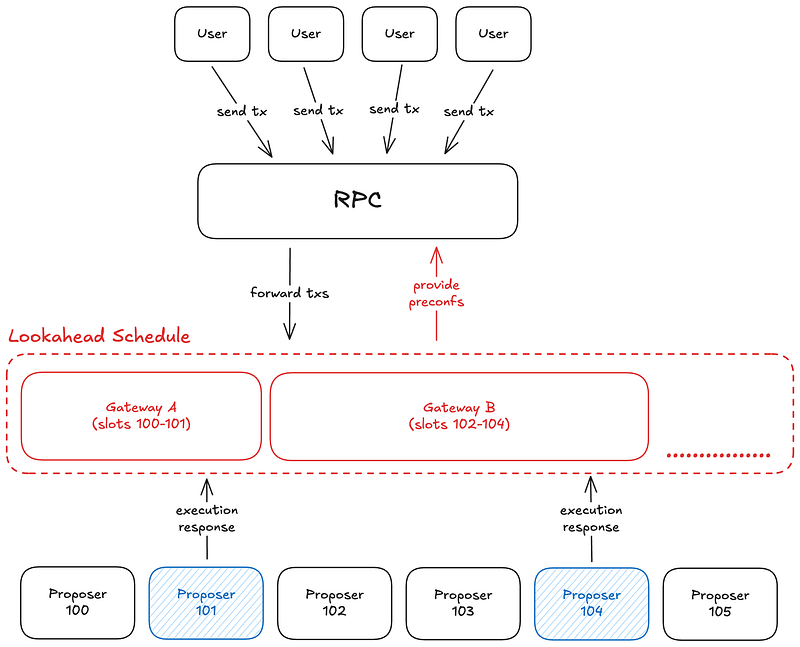
This is an introduction to gateway design. For full description visit https://ethresear.ch/t/becoming-based-a-path-towards-decentralised-sequencing/21733
L1 proposers establish a schedule of gateways called lookahead, which maps L1 slots in a given epoch to gateways. Each gateway holds the write access on the L2 state for a number of L1 slots, and must post these blocks as batches on the L1 via the rollup inbox contract. Because the gateway holds a temporary exclusive right to modify the L2 state, it can provide fast execution preconfs to users, before the batch is fully settled on the L1.
Block Production and Sync
Subsequent gateways in the lookahead schedule (e.g. Gateway B in the diagram) must obtain the latest L2 state to issue preconf after the slot transition. Other applications, such as explorers, wallets, and indexers, may also need access to the latest L2 state before it is settled on the L1. Relying solely on the L1 state (i.e. waiting for the L2 to sync after the batch has been posted) would result in “gaps” during which no preconf can be issued. This is because Gateway A needs to stop issuing preconfs X seconds before the start of the next L1 slot to ensure that the L2 batch gets settled on the L1, and Gateway B will only receive this updated state Y seconds after the start of the next L1 slot.
More detailed gateway architecture can be found here: https://gattaca-com.github.io/based-op/architecture/gateway#block-building--pipelining
Note that because these blocks are still not fully settled, there is still a possibility that a different batch will be posted on the L1, thus triggering a reorg on the L2.
Settlement and slashing
Gateways provide collateral to be able to enter the lookahead. The collateral is subject to slashing conditions e.g. when preconf promises are reneged, but also to incentives timely settlement of batches on the L1.
For example, if Gateway A fails to settle the required batch on the L1 by end of its slots, the next gateway in the lookahead schedule (Gateway B), will have to re-create and settle the L2 batch transaction(s). By doing so, Gateway B:
- can claim part of the collateral of the previous gateway (i.e. the faulty gateway is slashed). The slash amount should be proportional to the number of preconf blocks which haven’t landed
- avoids a L2 reorg and ensures that the L2 advances to where it started issuing preconfs on
In practice, when processing the L2 batch transaction, the inbox contract verifies if the signed blocks are signed by the previous gateway, and if so will slash its collateral and transfer it to the gateway posting the batch instead.
If, following a slashing event, the collateral amount falls below a specified threshold, the gateway will become ineligible for future lookaheads until the collateral is replenished.
Taking advantage of the EigenLayer slashing we can create a challenge period where the slashed gateway can submit a fault proof.
Slashing to Oblivion vs Redistribution to Preconf users
The logic behind slashing in Ethereum PoS is that, when a validator is penalized, all ETH holders are compensated via a reduction in the total ETH supply.
In Preconf slashing, the slashed ETH benefits participants who request or use the Preconf service. This redistribution mechanism — now offered by EigenLayer — fosters better economic alignment.
Preconf and Rewards Journey Phase 1
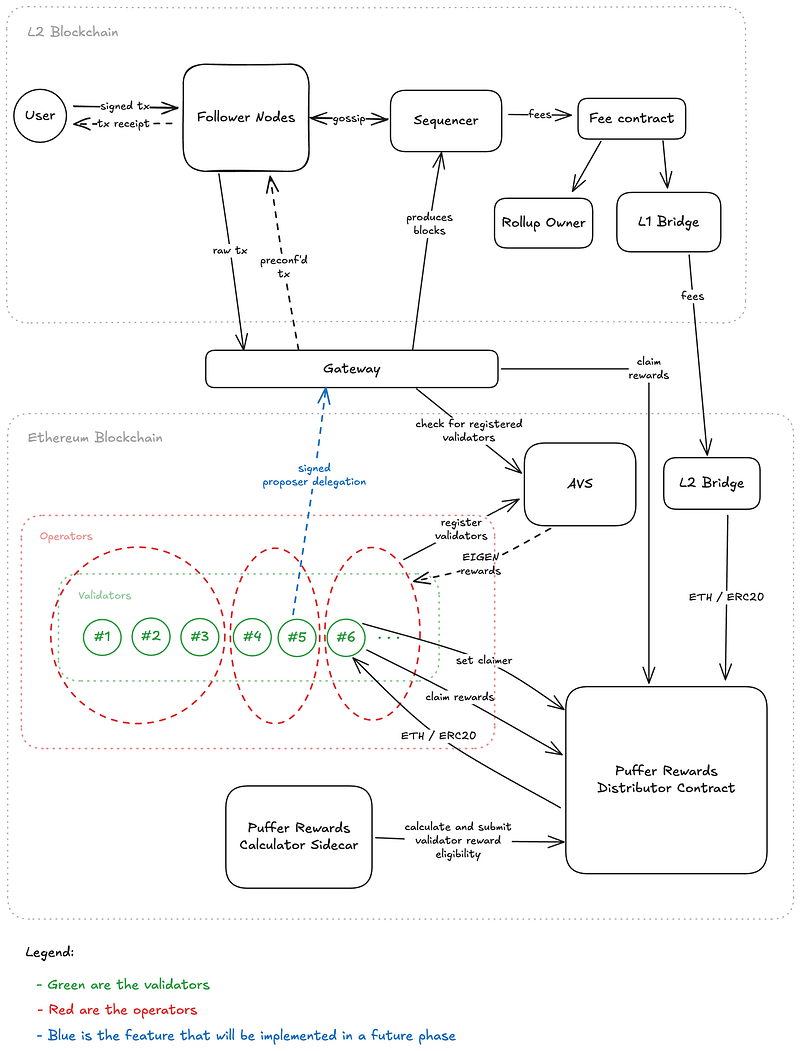
The rewards manager contract is linked to the block.coinbase of the rollup’s sequencer contract to receive rewards. Note that all priority or congestion fees can still be directed to the appchain or rollup owner.
From there, a portion of the rewards is distributed between the sequencer owner (app or rollup) and the Puffer UniFi AVS.
The Puffer UniFi AVS rewards sidecar then determines the reward split based on the performance of the validator and gateway.
Conclusion
Building on a based rollup — or migrating to one — doesn’t have to come at a high economic cost. Our preconf service offers a balanced economic model that fosters alignment. To achieve composability and eliminate the fragmentation caused by existing rollups, UniFi AVS provides economic alignment and robust security.
Puffer UniFi AVS on EigenLayer is the engine powering UniFi’s Based Rollup 10 ms transactions.
About Puffer Finance
Puffer Finance is a leading innovator in Ethereum infrastructure, focusing on next-generation rollups supported by liquid restaking (LRT) and preconfirmation as an AVS. With products like Puffer UniFi and Puffer UniFi AVS on EigenLayer, we are dedicated to enhancing Ethereum’s decentralization. Visit puffer.fi for more information.