The Hidden Risk in Your Institutional ETH Stack: Why Slashing Matters More Than You Think

Less than 0.04% of Ethereum Validators have ever been slashed. About 472 out of more than 1.2 million. Sounds like a rounding error, right?
But here’s what those numbers miss: slashing statistics capture outcomes, not exposure. When something goes wrong at an institutional scale, the math changes fast.
In our previous article, we examined how custody failures often stem from systems functioning exactly as designed, where the design itself is the problem. Slashing risk follows a similar pattern. The validator setup works fine until an assumption buried three layers deep proves to be incorrect.
TL;DR
- Slashing occasionally happens (0.04%), but most incidents stem from operational mistakes, not attacks.
- At the institutional scale, correlated failures across shared infrastructure multiply penalties fast.
- Puffer’s 2 ETH bond structure means operators underwrite their own risk, protecting staked ETH from validator mistakes.
- Staker funds stay protected unless over 2% of all Ethereum validators get slashed simultaneously.
What is Slashing?
Slashing is Ethereum’s way of keeping validators honest. When a malicious validator threatens network integrity, the protocol automatically penalizes them by burning a portion of their staked ETH and forcibly ejecting them from the validator set.
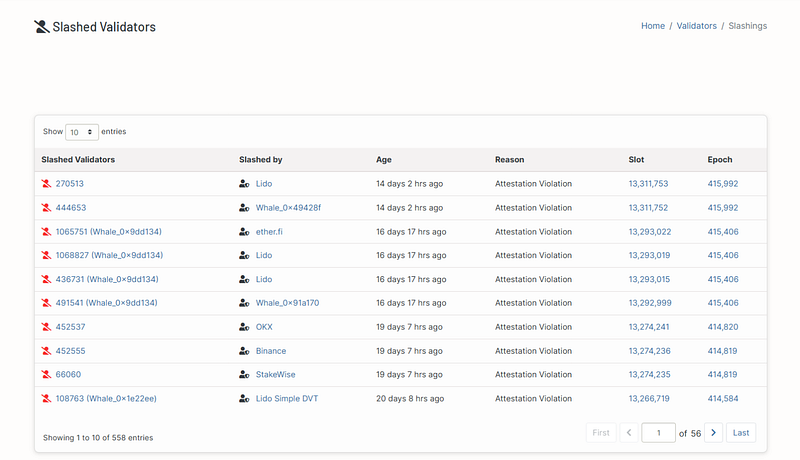
https://beaconcha.in/validators/slashings
Economic security exists to ensure Ethereum’s trustless state. Validators have real skin in the game, and slashing ensures that attacking or destabilizing the network costs more than it could ever be worth. Without it, proof-of-stake wouldn’t work.
The problem is that slashing doesn’t distinguish between malicious intent and honest mistakes. The protocol only sees the action, not the reason behind it.
When Does Slashing Occur?
Ethereum defines three specific actions that trigger slashing:
- Double proposing: Proposing and signing two different blocks for the same slot
- Surround voting: Attesting to a block that “surrounds” another, effectively rewriting history
- Double voting: Attesting to two candidate blocks for the same slot
When most people hear the term “slashing”, they picture some rogue validator attacking the network. Maybe a coordinated assault on Ethereum’s consensus. The reality? Far more boring. And honestly, more worrying because of it.
Scale Changes Everything
Solo validator gets slashed? Painful, but survivable. Rotate keys, move on.
Institutional staking doesn’t work that way.
Deploy dozens or hundreds of validators, and that “rare” 0.04% stops being negligible. Run the probability across a large enough set, and you probably should have planned for at least one incident.
Here’s where it gets worse. Ethereum’s slashing penalties scale with correlation, and to date, no correlated slashing event has occurred. But with more institutions beginning to stake, it’s a matter of when, not if.
An isolated mistake costs around 1 ETH. But if multiple validators misbehave simultaneously because they share infrastructure, or run the same buggy client version, each penalty multiplies. The protocol assumes correlated failures signal systemic risk, so the slashing penalty will increase with respect to the total validators slashed within 18 days.
This isn’t a bug. It’s intentional. Ethereum rewards diversification and punishes concentration.
Institutions with tightly coupled validator infrastructure are sitting on hidden leverage. What looks like a contained operational hiccup could cascade into something much larger if it touches multiple validators at once. Most risk models we’ve seen don’t account for this properly. They treat validators as independent when the infrastructure underneath them isn’t independent at all.
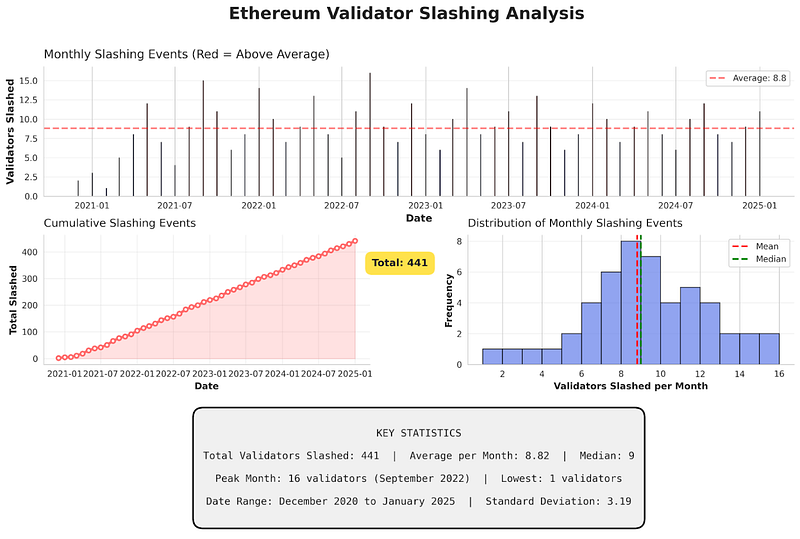
Historical slashing data pulled from https://beaconcha.in/validators/slashings
Nearly every slashing event on record traces back to operational mistakes. Someone spins up a backup node without proper safeguards. Validator keys get reused across machines by accident. A client bug causes an inadvertent rule violation. An AWS outage hits at exactly the wrong moment.
We’ve talked to operators who’ve been slashed and genuinely had no idea what happened until they dug through logs for hours. None of this requires malicious intent. A misconfigured redundancy setup can trigger double-signing without anyone realizing until the penalty hits.
How Puffer Addresses Slashing Risk
Most slashing protection boils down to “be careful” and “follow best practices.” That’s not nothing. But it’s not architecture either.
Puffer takes a different approach. Instead of trying to prevent every possible slashing scenario, we’ve designed a system where operational risk is underwritten by the node operator, not absorbed by stakers.
Risk Buffer as Active Insurance
Here’s how it works. Every node operator Puffer puts up 2 ETH as collateral. If their validator gets slashed, that bond gets removed first. Staker funds aren’t touched. This matters more than it might sound. In most staking setups, slashing losses get socialized across the pool. Everyone takes haircut. The underlying assets backing the token shrink, which means the token itself is worth less ETH than before. That’s a depeg caused by actual loss of value, not a liquidity crunch or market panic, but a real reduction in what’s backing each token.
Puffer’s structure changes that dynamic entirely. The operator who made the mistake (or got unlucky) bears the cost. Stakers have a buffer. The underlying assets stay intact.
The operator that locks 2 ETH as collateral isn’t dead capital sitting in escrow, it still earns rewards. But that bond is first in line if anything goes wrong. It’s not a premium in the traditional sense. No one’s writing checks. What they’re doing is putting their own capital in the blast radius. Operations go smoothly? They keep everything and profit. A mistake triggers slashing? Their ETH absorbs the hit before it ever reaches stakers.
That’s the underwriting. Real skin in the game, not a fee passed downstream.
And here’s the part that often gets overlooked: for a slashing event to burn through more than the 2 ETH bond, over 2% of all Ethereum validators would need to get slashed in the same window. That’s the correlation penalty math we mentioned earlier. A localized failure (even a serious one) stays contained within the operator’s bond. It would take a catastrophic, network-wide event to touch the staker’s principal.
That’s not just risk mitigation, it’s active insurance built into the protocol.
Structural Isolation
The treasury operations are separated from validator operations by design. Private keys aren’t exposed in accessible environments. Withdrawal credentials go through verification layers. If something compromises one part of the system, it doesn’t cascade into everything else. The goal isn’t to promise nothing will ever go wrong. The goal is making sure that when something does, stakers aren’t the ones paying for it.
Puffer Institutional
For exchanges, asset managers, and hedge funds, Puffer Institutional allows them to keep full control over deposits and withdrawals. Institutions can decide how much to stake versus restake. With the ability to launch their own liquid staking tokens without handing authority to black-box logic that they can’t audit. As for the security framework, it’s been audited by BlockSec and SpearBit. Multiple revenue streams are available through traditional staking plus EigenLayer staking. And the operator-underwritten model means an institution’s staked ETH isn’t exposed to someone else’s operational mistakes.
Additionally, the ETH is not commingled with other depositors. Institutions can hold the permission to deposit and withdraw the assets only.
The Question Worth Asking
If you’re managing institutional ETH, slashing probably isn’t the priority. The statistics look reassuring. The current setup hasn’t had problems.
But the question isn’t whether slashing risk exists; it does. The question is whether your current infrastructure would prevent a correlated failure across your validator set, or just hope one doesn’t happen. Puffer exists for teams that would rather not find out the hard way. If you’re starting to wonder whether your current custody stack is actually designed for today’s slashing risk profile, that’s exactly the conversation we’re set up to have.
Read our previous piece on custody risk:Why Most Custody Stacks Are Still Underestimating Risk
More on Puffer’s staking and institutional staking solutions:https://docs.puffer.fi/yield/introdocs.puffer.fi/institutional