The Crunchy Carrot Campaign and Beyond

Dear Puffers 🐡,
Our recent days have been incredibly rewarding, filling us with immense excitement for Puffer’s future.
In less than a week after launching our early-depositors stage in the Crunchy Carrot Campaign, we surpassed $600M in TVL. This makes PufETH, our native Liquid Restaking Token (nLRT), one of the largest in the restaking space.
In this article, we answer some common community questions and concerns about the ongoing campaign. Follow along!
Made For Ethereum
The Puffer team’s alignment with Ethereum dates back to its early days, marked by our anti-slashing technology, Secure Signer, receiving a grant from the Ethereum Foundation. Furthermore, our collaborative efforts with Ethereum Core researchers on ZK-2FA, along with the deployment of Validator Tickets, underscore our commitment to researching technology to help Ethereum along its roadmap.
We firmly believe that what we are building at Puffer is the best solution to help maintain Ethereum’s decentralization as in-protocol solutions are being developed.
By lowering the bond for running an Ethereum validator to only 1 ETH and paying validators more through native restaking rewards, Puffer’s architecture has the potential to attract a more diverse set of validators to the network.
Native restaking also eliminates the need to restake third-party LST tokens, presenting a better alternative to one of the main threats to Ethereum’s decentralization, which is centralization around a single LST — currently, stETH by Lido.
However, native restaking is only superior to LST restaking if the validators that operate it are truly permissionless and decentralized. This is why Puffer was built to be permissionless from day one!
Eating 🥕 (stETH)
The Crunchy Carrot campaign is a way for the community to contribute to our mission of decentralizing Ethereum by depositing stETH in advance of our mainnet launch. It’s a fantastic opportunity for early believers to interact with an early version of our product while accumulating Puffer Points and EigenLayer points.
But why stETH deposits, you might ask? The main goal of the “eating the carrots” concept is to reduce the stETH dominance in the LST space.
An LST with more than 33% of the ETH staked represents a danger to the entire Ethereum ecosystem, as dominance could enable harmful practices like transaction censorship, MEV extraction, and block timing games. Currently, Lido is very close to the 33% cap.
To support our early believers and reward their trust, we deposited stETH into EigenLayer, enabling them to earn EigenPoints while awaiting the launch of our native restaking. Following our Phase 2 announcement, we want to remind everyone that all stETH deposited during the early-depositors phase will be converted into ETH with the launch of our mainnet. This involves withdrawing the stETH from our vault in EigenLayer and redeeming it for ETH through Lido. Withdrawals from Puffer will be enabled soon after the launch of the mainnet.
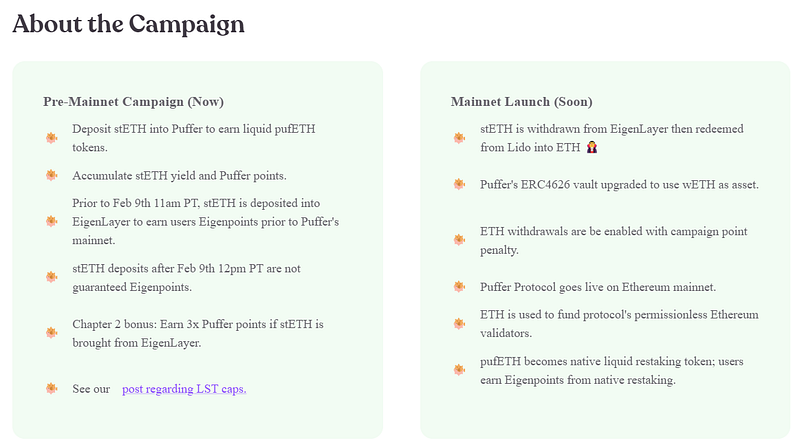
This ETH will fund permissionless validators for native restaking, fostering Ethereum’s credible neutrality and decentralization. This moment signifies Puffer’s transition to a permissionless native restaking protocol — and we’re excited to see everyone there!
To 🐡, With Love
As the next chapters of the Crunchy Carrot campaign unfold, we’d like to thank everyone again for trusting in our vision of a more decentralized and secure Ethereum for decades to come.
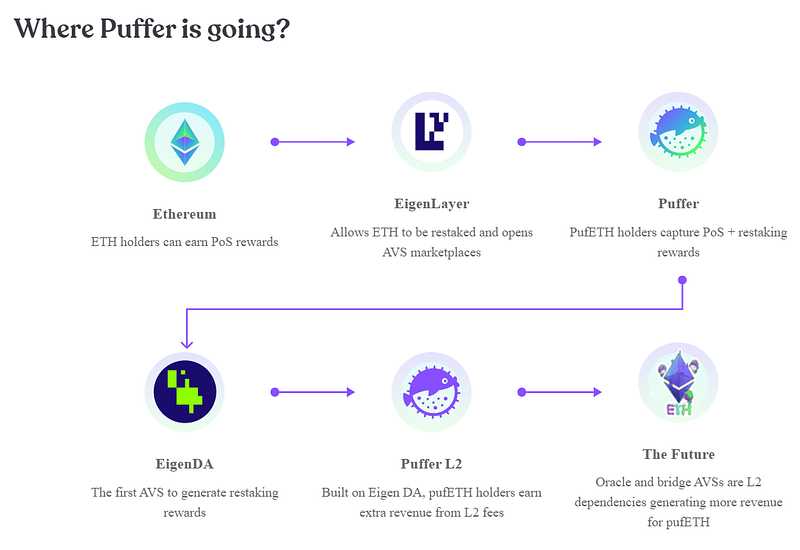
This is just the beginning of the Puffer journey. New uses for pufETH, DeFi integrations, exciting partnerships, and many ways to interact with our product while accumulating Puffer Points are on the horizon. We have a clear vision of where we are and where we want to be in the coming years, as shared in our roadmap.
You can join the Crunchy Carrot campaign by clicking here! To keep up with all the announcements, follow us on Twitter, join us on Discord or Telegram.